The following is an edited excerpt from the conference session “How to Move Jewish Institutions from a ‘Welcoming Approach’ to a ‘Belonging’ Atmosphere.”
How to Move Jewish Institutions from a “Welcoming” Approach to a “Belonging” Atmosphere
By Stacey Aviva Clark, Rivka Herzfeld, Ely Winkler and Marianne Novak
Panel:
Stacey Aviva Clark is the Director of Education and Community Engagement for the Jewish Federations of North America. Over her 25-year career, she has focused on combating racism and antisemitism and fostering Black / Jewish relations.
Ely Winkler is the Director of Advancement at Eshel, whose mission is to serve Orthodox LGBTQ+ Jews, their families, and communities.
Rivka Herzfeld is a disability awareness educator and Tanakh teacher.
Rabbi Marianne Novak (Moderator) is a member of the Judaic Studies faculty at Akiba-Schechter Jewish Day School in Chicago, Illinois and the faculty of the Jewish Learning Collab and Melton+ and serves as the rabbinic advisor for the Skokie Women’s Tefillah Group.
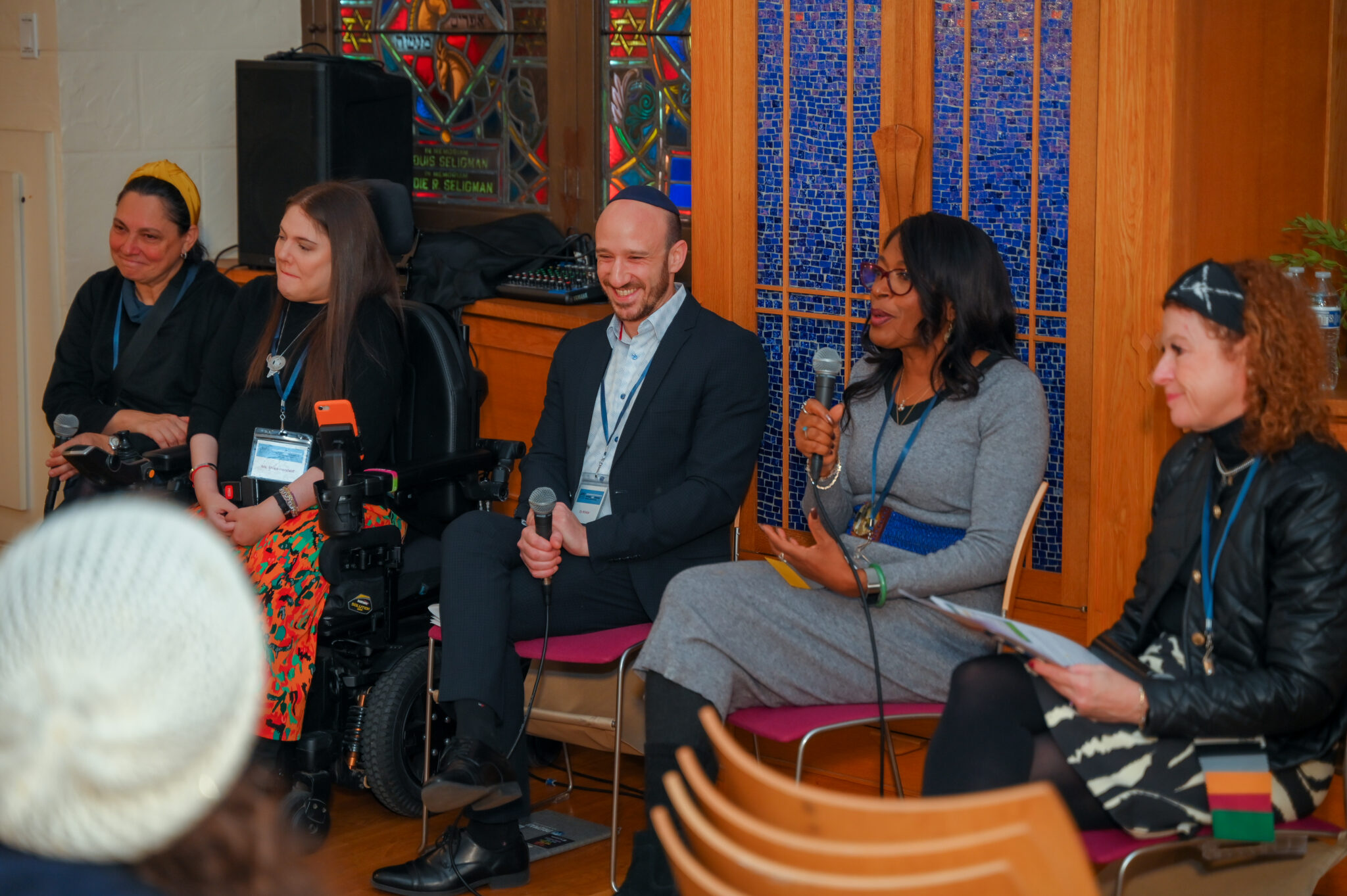
L to R: Rabba Daphne Lazar Price, Rivka Herzfeld, Ely Winkler, Stacey Aviva Clark, and Rabbi Marianne Novak
Rabbi Marianne Novak: In this session we’re going to be talking about inclusion. But what do we really mean by it? What does it look like practically in our Jewish institutions and our communities? To start, how does Torah inform your belonging? And what does “belonging” mean in a Jewish context?
Stacey Aviva Clark: I believe that Torah is the foundation of belonging. We are a disparate group of people who are very different from one another, yet connected by Torah and by this vision of having lev eḥad—one heart. One of the texts that I really appreciate is in Genesis 48 where Jacob says that God promised to make him into a “kahal amim”—a congregation of peoples. Commenting on this verse, Rabbi Samson Raphael Hirsch says that the strength of the Jewish people lies in our diversity. That’s the foundation of belonging. We’ve got to figure out how to belong together with one another when we’re all so different. It gives us an opportunity to look for the places where we fit. I often think of a mosaic. If you have a mosaic, you have all these different pieces. Separately, it’s just a big mess of pieces. But when you put them together, it makes this vibrant, beautiful picture.
Ely Winkler: For me as an LGBTQ person, the term “belonging” can mean many different things. Does it mean that you’re included? Does it mean that you’re tolerated? Does it mean that you’re fully welcome? The way the Torah informs my vision of Orthodoxy is based on a teaching by my teacher, Rabbi Steven Greenberg, one of the co-founders of Eshel: the Torah is a blueprint for our lives and no blueprint has every detail and every nuance captured. The stories in the Torah of people who advocate for themselves, such as B’not Zelophehad, the stories of those who are different speaking to their leaders and rabbis and changing the conversation throughout our Jewish peoplehood—not going against Hashem in any way, but advocating for their own difference. That’s how I see how belonging and inclusion fitting into the Jewish framework.
Rivka Herzfeld: To me, belonging means being part and parcel of the whole. It means that there’s a literal space for you when you come into the shul. It means that you’re able to get into the shul. It means that there are structural allowances, and there are no barriers for one to get in. It means that there are accessible things for people, such as accessible bathrooms. It means that there are Braille ḥumashim and siddurim if a shul can afford that. It means that there are Hebrew-English ḥumashim and siddurim. It means that there might be different minyanim, such as a slower-paced minyan or a fast-paced minyan.
A lot of people in Tanakh have disabilities, and the Tanakh does not shy away from that. Yitzḥak is blind, Yaakov has a limp because of his fight with the angel, Moshe has difficulty speaking, and Yonatan’s son Mephiboshet was lame. These are important texts that can inform Jewish belonging because our forefathers did that.
Read the rest at https://www.jofa.org/article/how-to-move-jewish-institutions-from-a-welcoming-approach-to-a-belonging-atmosphere/